The Great Debate
This is one of the most common questions in backyard BBQ, and unfortunately, the internet is full of people who already own one type telling you the other type is garbage. Let's skip that.
Both charcoal and pellet grills make great food. They do it differently, and which one is "better" depends entirely on what you want out of your grilling and smoking experience. Here's an honest breakdown.
How Each One Works
Charcoal Grills
Charcoal grills burn either briquettes or lump charcoal as their fuel source. The charcoal is lit, allowed to ash over, and then the food cooks over the radiant heat and hot coals.
Common types:
•Kettle grills (Weber Kettle) — The classic. A bowl-shaped bottom holds charcoal, a grate sits above, and a lid with vents traps heat and smoke. Simple, versatile, and time-tested. You control temperature by adjusting intake and exhaust vents.
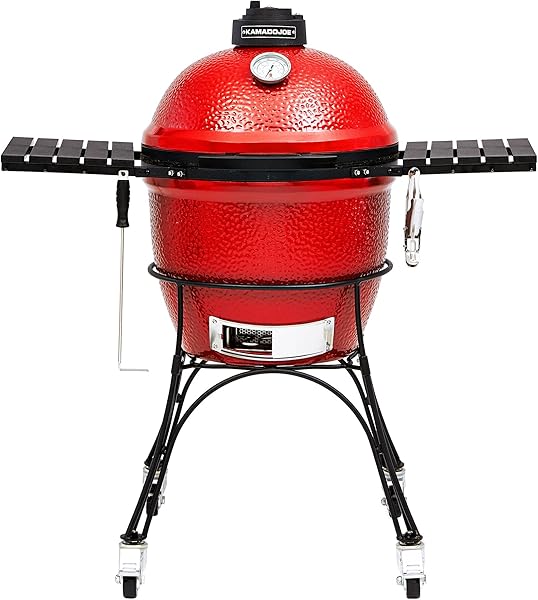
•Kamado grills (Big Green Egg, Kamado Joe) — Thick ceramic walls provide incredible insulation and heat retention. They're extremely fuel-efficient and can hold precise temperatures for long cooks. They can also reach 700°F+ for pizza and searing.
•Offset smokers — A separate firebox attached to a cooking chamber. You burn wood and/or charcoal in the firebox, and the heat and smoke flow through the cooking chamber. This is the traditional competition and restaurant setup but requires the most skill and attention.
Fuel: Briquettes vs Lump
•Briquettes (Kingsford is the standard) are uniform in size, burn consistently, and are easy to find. They contain binders and filite — purists don't love that.
•Lump charcoal is pure charred wood — no additives. It burns hotter, lights faster, and produces less ash. But it's irregular in size, which can mean uneven heat. It also burns faster than briquettes.
Pellet Grills
Pellet grills (sometimes called pellet smokers) use compressed wood pellets — small cylinders made from hardwood sawdust, held together by the wood's natural lignin. No chemicals or binders.
Here's how they work:
1.Pellets are stored in a hopper (a bin that holds 10-40 lbs of pellets).
2.An electric auger (a screw-shaped mechanism) feeds pellets from the hopper into a fire pot.
3.A hot rod igniter lights the pellets in the fire pot.
4.A fan circulates heat and smoke through the cooking chamber (convection cooking).
5.A digital controller monitors the temperature and adjusts the auger speed — feeding more pellets to raise the temp, fewer to lower it.
The result is a system that maintains temperature almost automatically. Set it to 225°F, and it holds 225°F. Popular brands include Traeger, RecTeq, Camp Chef, Green Mountain Grills, and Pit Boss.
Flavor
This is where the debate gets heated (no pun intended).
Charcoal Flavor
Charcoal produces a distinctive flavor that's hard to replicate. It comes from two sources:
1.The charcoal combustion itself — burning charcoal produces specific aromatic compounds that contribute to that classic "grilled" taste.
2.Drippings hitting the coals — when fat and juices drip onto hot charcoal, they vaporize and rise back up to flavor the food. This creates that unmistakable char-grilled flavor that's different from oven-cooked or gas-grilled food.
When you add wood chunks to charcoal, you get additional smoke flavor on top of the charcoal base. The combination is potent.
Pellet Grill Flavor
Pellet grills produce smoke flavor, but it's milder and cleaner than charcoal. The pellets are burning in a small fire pot with controlled airflow, producing thin, clean smoke. You won't get the heavy smoke ring or intense smokiness that a charcoal smoker delivers.
Some specific notes:
•At low temperatures (180-250°F for smoking), pellet grills produce more smoke and the flavor is quite good. Many people find smoked briskets and pork shoulders from pellet grills to be excellent.
•At high temperatures (350°F+), the auger feeds pellets so fast that they burn very cleanly, producing minimal smoke flavor. Grilling a burger at 450°F on a pellet grill gives you very little smoke character — it tastes more like an oven-cooked burger than a charcoal-grilled one.
•Dripping vaporization is less pronounced because pellet grills use a heat deflector/drip tray between the fire pot and the grate.
The honest verdict on flavor: Charcoal wins. Not by a landslide for low-and-slow smoking, but decisively for grilling. If maximum smoke flavor and that charcoal-grilled taste are your top priorities, charcoal is the answer. That said, most casual eaters can't distinguish pellet-smoked brisket from charcoal-smoked brisket in a blind test. The difference is more noticeable to experienced BBQ cooks.
Temperature Control
Charcoal
Temperature control on charcoal is a manual, learned skill.
•Kettle grills: You adjust the intake vent (bottom) and exhaust vent (top) to control airflow. More air = hotter fire, less air = cooler fire. It takes practice to dial in a specific temperature, and external factors (wind, ambient temperature, sun exposure) constantly push the temperature around. You'll be making adjustments throughout a cook.
•Kamado grills: Much easier to control than kettles because the thick ceramic insulation buffers against external conditions. Once a kamado is dialed in, it can hold a temperature for hours with minimal adjustment. Still manual, but more forgiving.
•Offset smokers: The most demanding. You're managing an actual fire, adding fuel regularly, and adjusting vents. Holding a steady 250°F in an offset requires attention and experience. It's an active process, especially in cold or windy weather.
Pellet Grills
Temperature control on a pellet grill is virtually automatic. You set the temperature on the digital controller (or the phone app, on modern models), and the controller adjusts the auger feed rate to maintain it. Temperature swings of 5-10°F are normal; swings of 15-20°F happen occasionally.
Modern pellet grills with PID controllers (proportional-integral-derivative) hold tighter temperatures than older models with simple time-based controllers.
The honest verdict on temp control: Pellet grills win decisively. It's not even close. If you want to set it and walk away — check on the kids, watch the game, take a nap — a pellet grill lets you do that. A charcoal smoker demands your attention.
Learning Curve
Charcoal has a real learning curve. Your first few cooks on a kettle or offset will involve temperature spikes, flameouts, and meat that's not quite what you planned. That's normal. It takes 5-10 cooks to start feeling comfortable with fire management, and many more to truly master it.
Pellet grills are nearly as easy as an oven. Load pellets, set temperature, place food, wait. Your first cook will probably be solid. There's still a learning curve for understanding smoke levels, when to wrap, probe placement — but the fire management part is eliminated.
Who this matters to: If you enjoy the process of tending a fire and consider it part of the experience, charcoal is deeply satisfying. If you just want excellent smoked meat without the active fire management, pellet grills remove the biggest barrier.
Cost
Upfront Cost
•Charcoal kettle grill (Weber Original Kettle): ~$100-175. Arguably the best value in outdoor cooking.
•Kamado grill (Big Green Egg, Kamado Joe): $800-2,500+. Expensive, but they last decades.
•Offset smoker (quality models like Oklahoma Joe's Highland): $300-500. High-end offsets (Yoder, Lang) run $1,500-3,000+.
•Pellet grill (entry-level Pit Boss, Camp Chef): $400-600. Mid-range (Traeger, RecTeq): $800-1,200. Premium (Yoder YS640): $1,800+.
Charcoal wins on upfront cost at the entry level. A Weber Kettle is the cheapest way into serious outdoor cooking. At the mid-to-high end, the costs converge.
Ongoing Fuel Cost
•Charcoal: A 20 lb bag of Kingsford runs about $15-20 and lasts 2-4 long cooks. Lump charcoal costs more. A full brisket cook might use 15-20 lbs of charcoal plus wood chunks.
•Pellets: A 20 lb bag runs about $15-20 and lasts 2-3 long cooks at smoking temperatures. At higher grilling temps, pellets burn faster.
Roughly equivalent on fuel cost, though charcoal can be cheaper if you use a kamado (extremely fuel-efficient) and more expensive if you use a big offset smoker (fuel hog).
Maintenance and Repairs
•Charcoal grills have almost no moving parts. A Weber Kettle needs a new grate every few years. That's about it. They're bulletproof.
•Pellet grills have motors, augers, fans, controllers, igniters, and temperature probes — all of which can fail. Auger jams, igniter burnouts, and controller failures are common complaints. Repairs cost $30-150+ depending on the part.
Charcoal wins on longevity and reliability. A Weber Kettle from the 1990s is still cranking out food. A pellet grill from 2019 might need parts.
Versatility
Charcoal
Charcoal grills — especially kamados and kettles — are surprisingly versatile:
•Low and slow smoking (225-275°F) — excellent with proper setup
•Direct grilling (400-600°F) — the classic use case
•High-heat searing (600°F+, especially kamados) — steak, pizza
•Indirect baking/roasting — bread, pizza, turkey, anything you'd do in an oven
Pellet Grills
•Low and slow smoking (180-275°F) — the primary strength
•Indirect grilling/roasting (300-450°F) — works well
•High-heat searing — This is the weakness. Most pellet grills max out at 450-500°F. Some newer models have a direct-flame searing option (like the Camp Chef with the Sidekick or Traeger Flatrock), but it's an add-on, not a core feature. You won't get a good steakhouse crust from a standard pellet grill alone.
Charcoal wins on versatility, particularly for high-heat cooking. Pellet grills struggle with true searing.
Weather Performance
Charcoal: Wind is the enemy of charcoal cooking. A gusty day can wreak havoc on temperature control, especially in a kettle. Kamados handle wind well due to their mass. Cold weather drops temperatures and increases fuel consumption on all charcoal setups. Rain is obviously problematic.
Pellet grills: Also affected by cold and wind, but the electronic controller compensates by feeding more pellets. However, most pellet grills have thin steel walls with poor insulation. In truly cold weather (below 20°F), many pellet grills struggle to maintain temperature and burn through pellets at an alarming rate. Some manufacturers sell insulation blankets for winter use. Pellet grills should never be used in rain — moisture in the hopper can cause pellets to expand and jam the auger.
Neither wins cleanly here. Kamados handle all weather best. Standard pellet grills and kettles both struggle in extremes.
Who Should Buy What
Buy a Charcoal Grill If:
•You enjoy the hands-on process of managing fire
•Maximum flavor is your top priority
•You want to sear steaks at very high heat
•You want a simple, reliable machine with no electronics
•You're on a tight budget (kettle) or want a lifetime investment (kamado)
•You see fire management as a skill worth developing
Buy a Pellet Grill If:
•Convenience and consistency are your top priorities
•You want to smoke brisket, ribs, and pork shoulders without babysitting a fire
•You want to set it from your phone and walk away
•You cook for large groups regularly and need predictable results
•You're new to smoking and don't want the fire management learning curve
•You're honest with yourself that you won't get up at 3 AM to tend an offset
The Best of Both Worlds
Many serious BBQ enthusiasts own both — a pellet grill for long overnight smokes and a charcoal kettle or kamado for grilling and searing. If budget allows, this combination covers every cooking scenario.
Related Guides:
•Best Grills of 2026
•The Reverse Sear Method
•Texas-Style Brisket Guide